Brown Butter Cheesecake Bars with a Crack-Free Promise
A foolproof approach to creamy cheesecake bars that skip the water bath entirely, using brown butter and a gentle bake-and-rest technique to prevent splits and cracks.
The secret to crack-free cheesecake without a water bath lies in understanding what causes those fissures in the first place: rapid moisture loss and thermal shock. When you bake cheesecake in dry heat, the edges cook much faster than the center, causing the filling to pull and tear. By browning your butter first, you’re adding moisture and emulsifying the filling differently, which creates a tighter crumb structure that’s far more forgiving. The real magic, though, happens in the oven itself—a low, gentle heat combined with a long, undisturbed rest period while the oven cools lets the center set gradually without ever experiencing the stress of a sudden temperature change.
This method works because you’re respecting the transition between liquid and set. The filling should jiggle slightly—just a small wobble in the very center when you give the pan a gentle shake—when you remove it from the oven. That’s not undercooked; that’s perfect. The residual heat will finish the job as the whole thing comes to room temperature slowly, at its own pace, without any shock to the system. No water, no special equipment, no elaborate setup. Just patience and a good understanding of how heat works.
Brown Butter Cheesecake Bars with a Crack-Free Promise
Serves 12 bars · Prep 20 minutes · Cook 50 minutes plus 3 hours resting
-
Heat your oven to 325°F. Line a 9-by-13-inch baking pan with parchment paper, leaving an inch of overhang on the long sides. Brown 6 tablespoons of butter in a small saucepan over medium heat, stirring occasionally until the milk solids turn deep golden and smell nutty—about 5 minutes. Let cool slightly, then pour into a bowl with the graham cracker crumbs, 2 tablespoons sugar, and 1/4 teaspoon salt. Toss until the texture resembles wet sand.
-
Press the mixture firmly and evenly into the bottom of the prepared pan, using the bottom of a measuring cup to create an even, compact layer. Bake for 8 minutes until it’s set and fragrant, then remove and let rest while you prepare the filling.
-
While the crust bakes, beat the room-temperature cream cheese and softened butter together on medium speed for 3 minutes until completely smooth and pale—this aerates the filling and prevents dense pockets. Scrape down the bowl frequently.
-
In a separate small bowl, whisk together the cornstarch and salt. Add the sugar to the cream cheese mixture and beat on medium for another minute until combined. Pour in the eggs one at a time, beating on low speed after each addition until just incorporated—do not overmix. Add the sour cream, vanilla, and the cornstarch mixture, beating on low until just combined and smooth.
-
Pour the filling over the cooled crust, smoothing the top with a spatula. Place the pan in the oven and bake at 325°F for 45-50 minutes. The edges should look set and very slightly puffed, but the center 2-inch circle should still have a noticeable jiggle when you give the pan a gentle shake from side to side—like barely-set Jello.
-
Turn off the oven, crack the door open about 2 inches, and leave the pan inside for exactly 1 hour. This gradual cooling is what prevents cracking. After 1 hour, remove the pan and let it cool to room temperature on a wire rack—about 1 to 1.5 hours more.
-
Once at room temperature, cover the pan with plastic wrap and refrigerate for at least 3 hours, preferably overnight. The cheesecake continues to set as it chills.
-
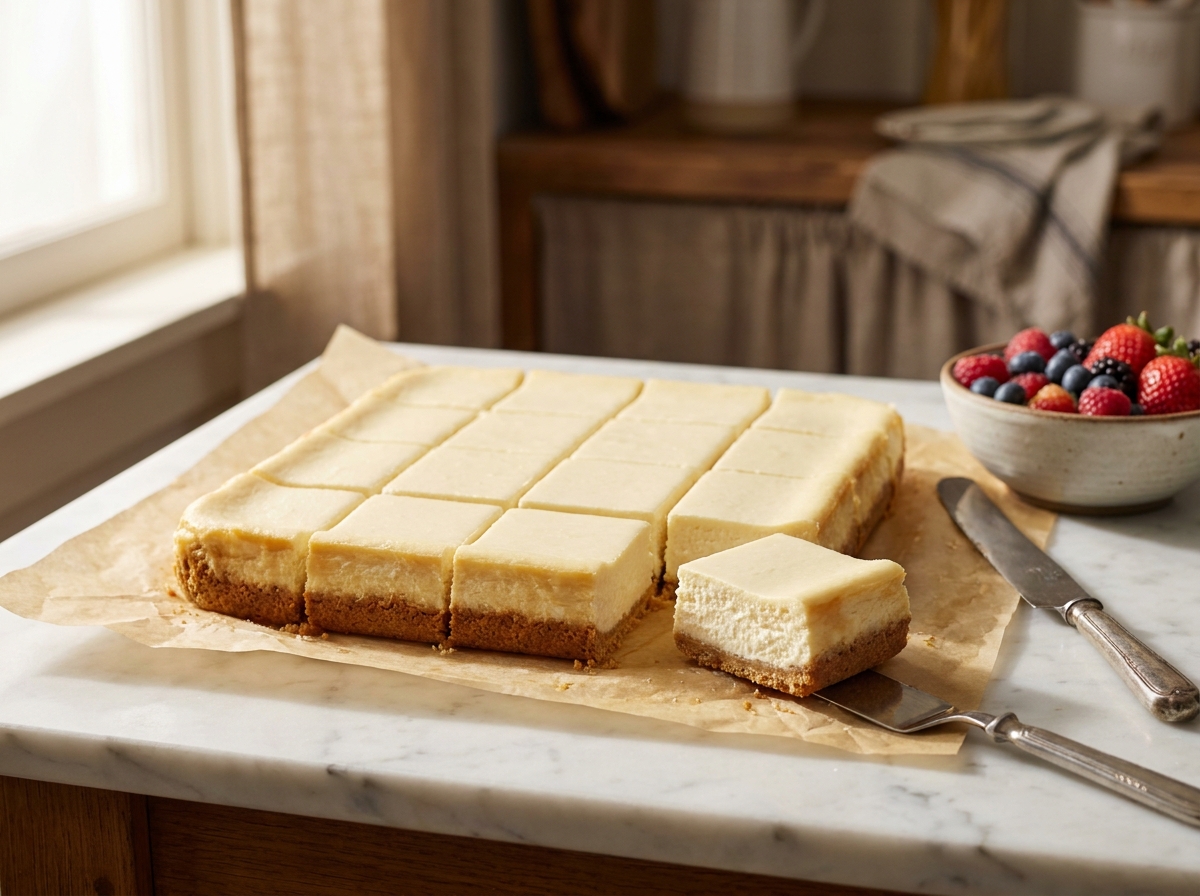
Run a thin knife around all edges to loosen the bars, then use the parchment overhang to lift the entire cake onto a cutting board. Cut into 12 even bars using a sharp, hot knife, wiping it clean between cuts for neat edges.