Cinnamon Swirl Bread with No Gap Promise
A tender, buttery loaf with a tight cinnamon ribbon that stays bonded to the crumb, solved by a simple pressure technique during shaping.
The gap that forms between cinnamon swirl and bread crumb happens because air pockets develop when you roll the dough loosely or let it rest too long before baking. The dough expands upward in the oven, pulling away from the filling. The fix is counterintuitive: you need to seal the swirl tightly into the dough during shaping, then gently compress the rolled log before it goes into the pan. This firms up the connection between filling and crumb so they rise together as one unit.
We’ll use a rich, slightly sweet dough with milk and an egg to keep the crumb tender, and we’re not shy with the cinnamon mixture—brown sugar, butter, and spice packed into every layer. The key moment comes right after rolling: use your palms to apply steady, even pressure along the entire length of the log, sealing those cinnamon particles into the dough structure. When you place it seam-side down in the pan, you’re not just setting it down; you’re pressing it gently so the bottom makes full contact with the pan surface.
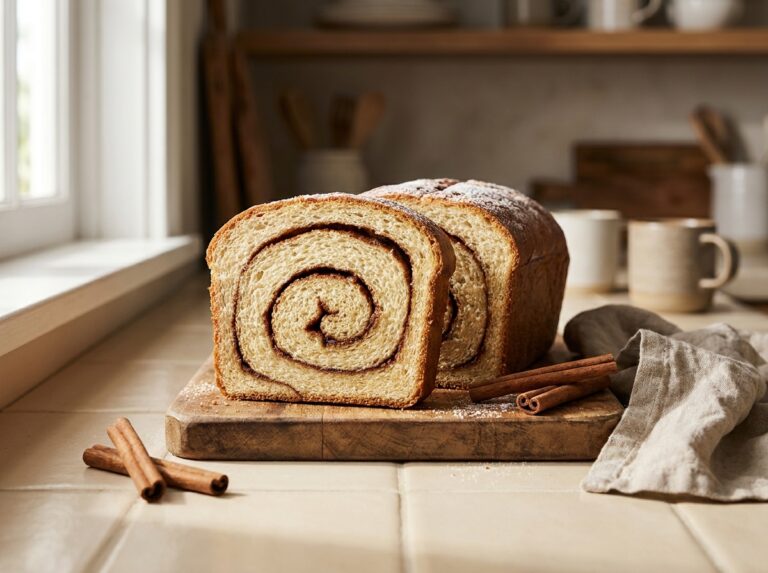
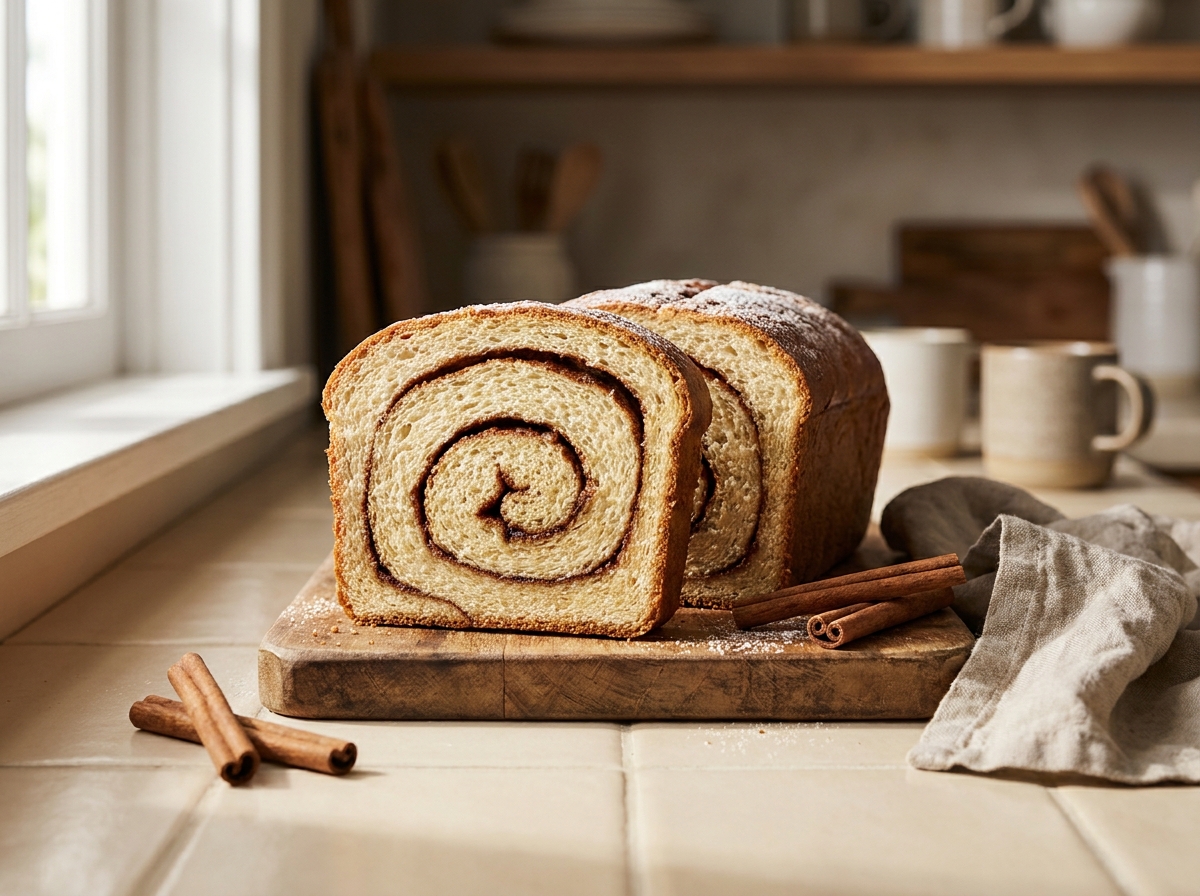
The result is a loaf with a dark, glossy swirl that runs all the way through without fracturing or gapping. Each slice shows the cinnamon ribbon exactly where it should be, married to the crumb rather than floating above it.
Cinnamon Swirl Bread with No Gap Promise
Serves 1 loaf, 10 slices · Prep 2 hours 30 minutes · Cook 35 minutes
-
Combine warm milk, yeast, and a pinch of the granulated sugar in a large bowl; let sit for 5 minutes until foamy and fragrant at the surface.
-
Whisk in the remaining granulated sugar, egg, and melted butter until combined, then add salt and stir.
-
Add flour one cup at a time, stirring with a wooden spoon until the dough comes together in a shaggy mass that clears the sides of the bowl.
-
Turn dough onto a lightly floured surface and knead for 8 to 10 minutes, using the heel of your hand to push and fold, until the dough becomes smooth, elastic, and slightly tacky but not sticky to the touch.
-
Transfer to a lightly oiled bowl, turning to coat all sides, cover with a damp towel, and let rise at room temperature for 1 hour 15 minutes until puffy and roughly doubled in volume.
-
While dough rises, mix softened butter, brown sugar, cinnamon, and salt in a small bowl until you have a thick, spreadable paste with no lumps of brown sugar visible.
-
Turn risen dough onto a lightly floured surface and pat gently into a rough rectangle about 8 by 10 inches, with the longer side facing you.
-
Spread the cinnamon mixture evenly over the dough surface, leaving a half-inch border at the far edge, and use an offset spatula or the back of a spoon to ensure even coverage with no bare spots.
-
Starting at the edge closest to you, roll the dough away from your body into a tight log, pressing gently as you go to seal in the filling, then pinch the seam closed once you reach the far edge.
-
Place the rolled log seam-side down on your work surface and use both palms to apply gentle, even pressure along its entire length for about 10 seconds, compressing the dough to seal the filling tightly into the crumb structure.
-
Transfer the log seam-side down into a buttered 9-by-5-inch loaf pan, pressing gently so the bottom makes full contact with the pan surface, then cover loosely with plastic wrap or a damp towel.
-
Let rise at room temperature for 50 minutes to 1 hour until the dough rises just above the rim of the pan and springs back slowly when gently poked.
-
Meanwhile, preheat oven to 375°F.
-
Brush the top of the risen loaf lightly with water or a whisked egg white, then sprinkle evenly with the cinnamon sugar mixture.
-
Bake for 35 to 38 minutes until the top is deep golden brown and a skewer inserted into the center comes out clean with no doughy crumbs clinging to it.
-
Let cool in the pan for 10 minutes, then turn out onto a wire rack to cool completely before slicing, about 45 minutes, so the crumb sets and the swirl remains intact.